Introduction
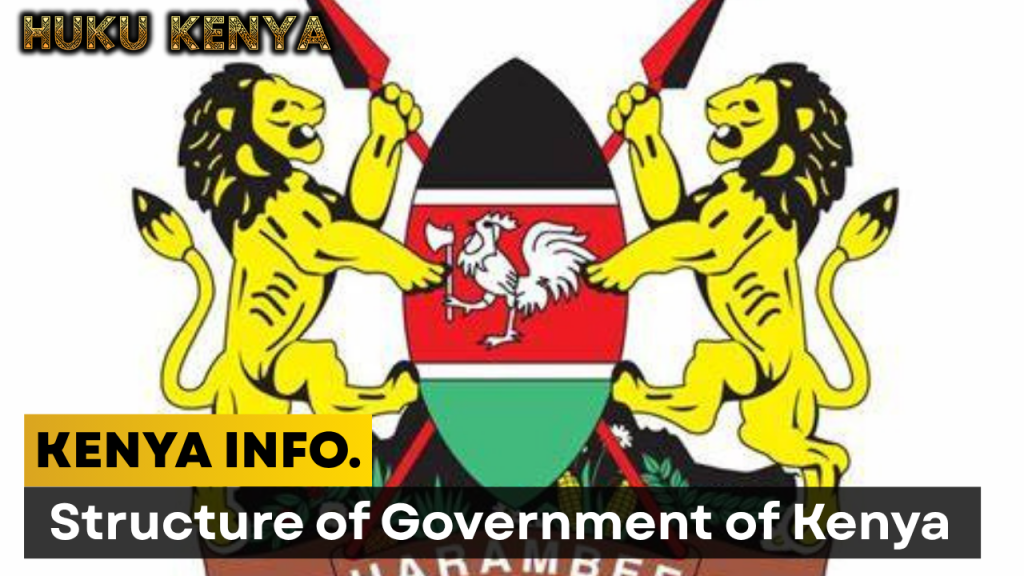
The Government of Kenya operates under a unitary system with a decentralized structure, as established by the Constitution of Kenya 2010. This structure is designed to ensure efficient governance and equitable distribution of resources across the country. The government is divided into two levels: the national government and the county governments. This article provides an in-depth look at the structure of the Government of Kenya, highlighting its key components and functions.
National Government
Executive Branch
The Executive branch of the Government of Kenya is headed by the President, who is both the head of state and government. The President is elected by popular vote and serves a five-year term, with the possibility of re-election for one additional term. The Executive branch also includes the Deputy President, Cabinet Secretaries, and Principal Secretaries.
Key Functions of the Executive Branch:
- Implementing and enforcing laws
- Formulating and executing national policies
- Representing Kenya in international affairs
- Commanding the Kenya Defence Forces
The President appoints Cabinet Secretaries, who are responsible for various ministries such as Health, Education, and Interior. These appointments are subject to approval by the National Assembly.
Legislative Branch
The Legislative branch, also known as Parliament, is bicameral, consisting of the National Assembly and the Senate. This branch is responsible for making laws, approving the national budget, and overseeing the Executive.
National Assembly:
- Composed of 349 members, including 290 elected from constituencies, 47 women representatives, 12 nominated members, and the Speaker.
- Responsible for passing legislation, representing the people, and overseeing the Executive.
Senate:
- Composed of 67 members, including 47 elected from counties, 16 women representatives, 2 youth representatives, 2 representatives for persons with disabilities, and the Speaker.
- Responsible for representing the interests of counties, protecting devolution, and overseeing county governments.
Judiciary
The Judiciary is an independent branch responsible for interpreting and applying the law. It ensures justice is administered fairly and impartially. The Judiciary is headed by the Chief Justice and includes the Supreme Court, Court of Appeal, High Court, and subordinate courts.
Key Functions of the Judiciary:
- Interpreting the Constitution and laws
- Resolving disputes
- Protecting the rights and freedoms of individuals
- Ensuring the rule of law
County Governments
Kenya is divided into 47 counties, each with its own semi-autonomous government. County governments are responsible for local governance and service delivery. They operate under the principles of devolution, which aim to bring government closer to the people and promote local development.
Structure of County Governments:
- County Executive: Headed by the Governor, who is elected by the county’s residents. The Governor is assisted by the Deputy Governor and County Executive Committee members.
- County Assembly: Composed of elected Members of the County Assembly (MCAs) and nominated members. The County Assembly is responsible for making laws at the county level, approving the county budget, and overseeing the County Executive.
Key Functions of County Governments:
- Health services
- Agriculture
- County transport
- Trade development and regulation
- Pre-primary education
- County planning and development
Constitutional Commissions and Independent Offices
The Constitution of Kenya 2010 established several constitutional commissions and independent offices to enhance governance, accountability, and transparency. These bodies are independent and are not subject to direction or control by any person or authority.
Key Constitutional Commissions:
- Independent Electoral and Boundaries Commission (IEBC): Responsible for conducting elections and referenda.
- Kenya National Commission on Human Rights (KNCHR): Promotes and protects human rights.
- Ethics and Anti-Corruption Commission (EACC): Investigates and prevents corruption.
- Commission on Revenue Allocation (CRA): Advises on the equitable distribution of revenue between the national and county governments.
Independent Offices:
- Auditor-General: Audits public accounts and reports on the use of public funds.
- Controller of Budget: Oversees the implementation of the national and county budgets.
Conclusion
The structure of the Government of Kenya is designed to ensure effective governance, promote democracy, and enhance service delivery. The national government, with its Executive, Legislative, and Judiciary branches, works in tandem with the county governments to address the needs of the Kenyan people. The constitutional commissions and independent offices play a crucial role in promoting accountability and transparency. Understanding this structure is essential for appreciating how Kenya’s government functions and serves its citizens.